Imagine that a significant percentage of your potential customers cannot navigate your website easily. Imagine, too, that without realising it, you are excluding people who want to buy your products, access your services or simply find information on your digital platform. Today more than ever, web accessibility for people with disabilities is not only an ethical imperative: it is a key factor in helping your business connect with society as a whole, comply with the law and improve its search engine ranking.
In this complete guide, we explore what web accessibility is, who it benefits, why you should incorporate it into your digital strategy and how tools such as Acctua can help you achieve it quickly, professionally and effectively.
1. What is web accessibility and why does it matter?
Web accessibility for people with disabilities means that your pages, content and functionalities are designed so that everyone — including people with visual, hearing, motor or cognitive disabilities — can perceive, navigate, understand and interact with your website without barriers or obstacles.
This includes aspects such as:
- Alternative text for images
- Clear navigation structures
- Compatibility with tools such as screen readers
- Adjustable colours, fonts and visual elements
It is not just about complying with a technical regulation; it is about making your website usable for everyone. Moreover, accessibility also benefits people without disabilities, such as older users, those browsing on mobile devices with limitations, or people with temporary disabilities (for example, a broken arm).
2. How many people does this affect?
The data speaks for itself:
🌍 1 in 6 people lives with a disability
According to international studies, approximately 16% of the world’s population has a significant disability.
📍 More than 4 million people in Spain have a disability
In Spain, over 4 million people live with some form of disability, representing around 9% of the population.
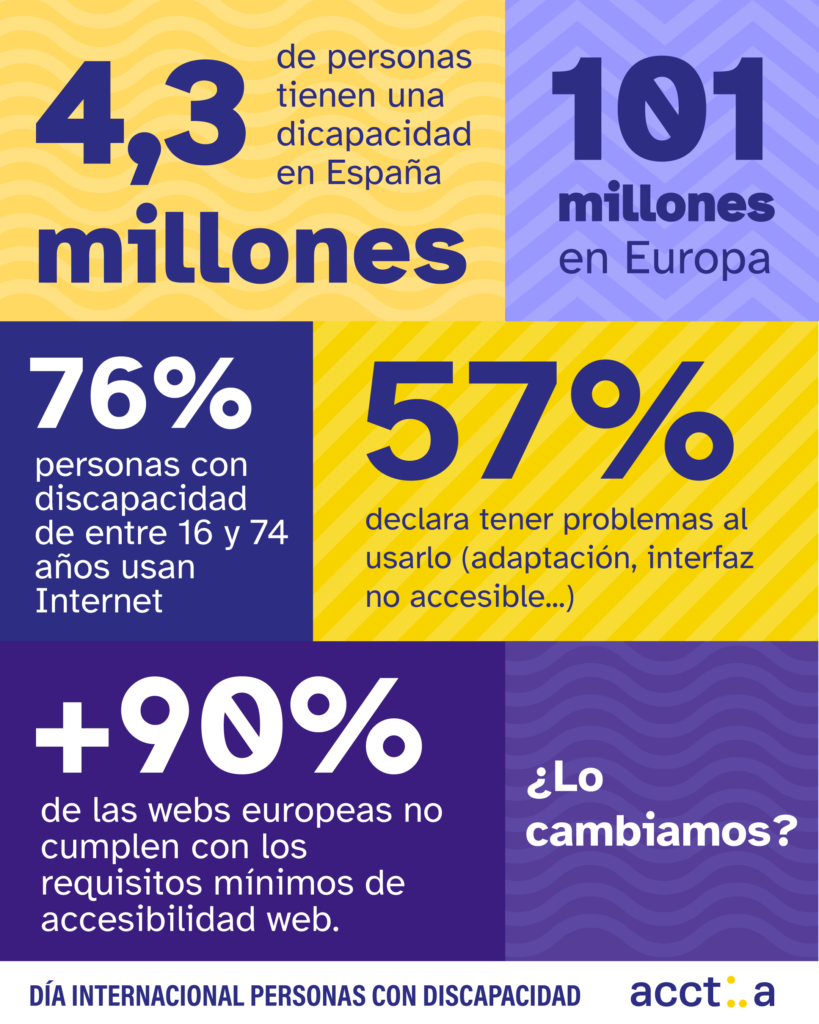
Behind these figures are real people who encounter invisible digital barriers every day. Below, we show some concrete examples.
Types of disabilities addressed by web accessibility
Web accessibility for people with disabilities is not limited to a single type of user. An inclusive website considers a wide range of needs, including:
- Visual disabilities: people who are blind, have low vision or colour blindness. They benefit from alternative text for images, sufficient colour contrast and compatibility with screen readers.
- Hearing disabilities: people who are deaf or hard of hearing. They require subtitles for videos and transcripts for multimedia content.
- Motor or physical disabilities: people with reduced mobility, missing upper limbs or those who use assistive devices. They benefit from keyboard-accessible navigation and sufficiently large clickable elements.
- Cognitive or intellectual disabilities: people with difficulties related to comprehension, memory or concentration. They benefit from clear language, simple structure and intuitive navigation.
- Temporary or situational disabilities: such as a broken arm, older people with reduced vision, or users accessing websites on mobile devices with limitations. These users also benefit from accessible design.
Including solutions for all these groups ensures that your website is truly inclusive and usable.
3. Benefits you cannot afford to ignore
👉 Greater reach and better SEO
An accessible website is not only inclusive; it also improves your search engine ranking. Accessibility elements such as image descriptions (alt text), well-structured headings and clear navigation help search engines understand your content and rank it more effectively. Some studies estimate that this can increase visibility by up to 20%.
👉 More visits and higher conversion rates
Statistics show that accessible websites receive up to 12% more traffic and achieve better conversion rates in e-commerce environments.
👉 Customer loyalty
People with disabilities represent significant purchasing power, and 43% are more likely to buy from websites they can use easily.
👉 Improved user experience
Accessibility does not only benefit those who need it directly. Well-structured content, intuitive navigation and good usability improve the experience for all users.
Do you know your bounce rate? A portion of those users may be leaving your website simply because it is not accessible.
4. Accessibility and legal compliance
In Spain and across Europe, digital accessibility is no longer optional. From 28 June 2025, regulations transposing Directive (EU) 2019/882 require digital services to be accessible, including websites, applications and e-commerce platforms.
This involves:
- Complying with technical criteria (such as WCAG standards)
- Publishing an accessibility statement
- Maintaining communication channels for complaints and feedback
Beyond avoiding penalties, legal compliance is an opportunity to demonstrate your social commitment and digital quality.
5. What are the WCAG and how do they help?
The Web Content Accessibility Guidelines (WCAG) are international web accessibility standards created by the WAI initiative of the W3C.
These guidelines are structured into three levels:
- A: Basic level
- AA: Intermediate level (recommended for most websites)
- AAA: The most demanding level
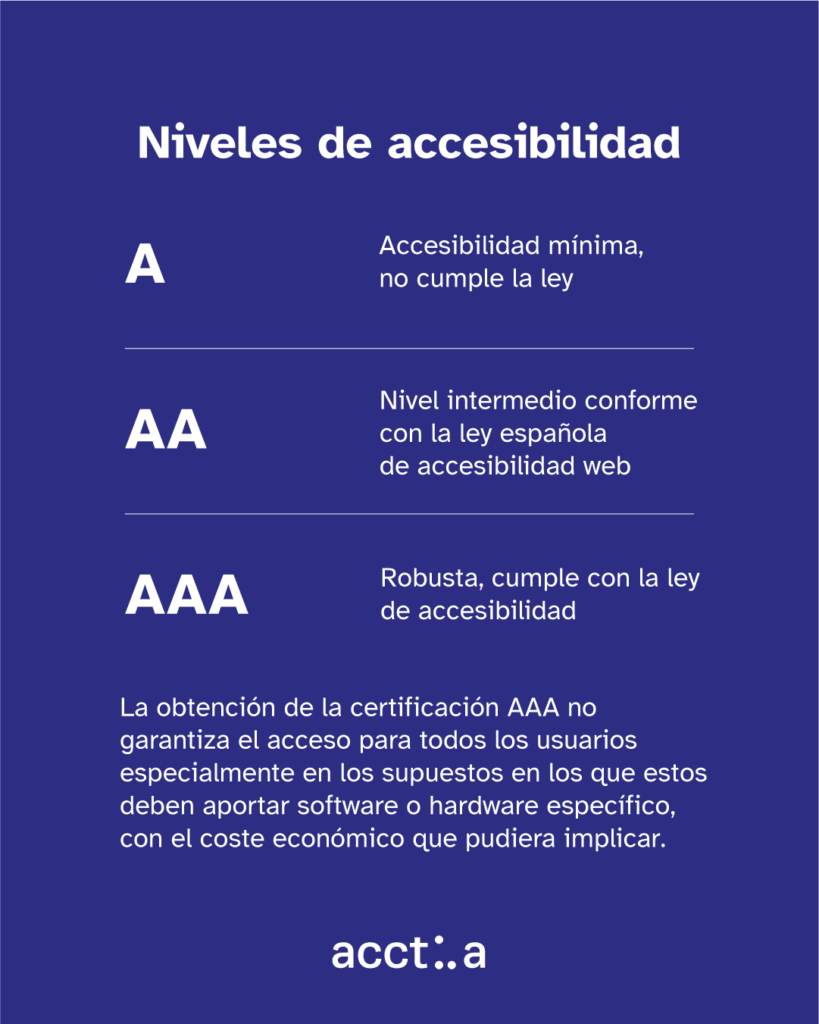
Complying with WCAG 2.1 or 2.2 ensures that your website is designed with people with visual, hearing, motor and cognitive disabilities in mind.
6. Common barriers faced by people with disabilities
Even a well-built website can present barriers without you realising it. Common examples include:
- Images without alternative text that screen readers cannot interpret
- Poorly structured headings that make navigation difficult
- Insufficient colour contrast that prevents people with low vision from reading content
- Inaccessible forms that cannot be completed without a mouse
These seemingly small omissions can frustrate users and cause them to leave your website without achieving their goal — even when they genuinely intended to buy, get information or contact you.
7. Tools and practices that work
To implement web accessibility for people with disabilities effectively, it is important to combine good development practices with audits and concrete actions. Some recommendations include:
✅ Use evaluation tools
There are solutions that automatically analyse your pages, such as Google Lighthouse. In addition, Acctua offers a free accessibility audit service that allows you to assess the current accessibility status of your website and receive a detailed report with clear, actionable recommendations. You can try it here:
https://www.acctua.eu/auditoria-web/
8. Where does Acctua fit into all this?
Accessibility is not about meeting minimum requirements; it is about deciding what kind of website — and what kind of company — you want to be.
This is where Accesit Inclusivo and our tool Acctua make the difference:
🔍 Professional diagnosis
We analyse your website to identify real accessibility barriers.
⚙️ Smart automation
We implement solutions that improve usability for people with disabilities without negatively affecting design or visual experience. You do not need to modify your website’s code.
📈 Improved SEO and usability
By making your website accessible, we also enhance its structure and visibility in search engines.
✔️ Accessibility statement and legal compliance
We help you generate the documentation required by current regulations.
🔄 Continuous improvement
Acctua is constantly updated: we add new features and adaptations so your website remains accessible without you having to worry about anything. Your site evolves automatically in line with regulations and best practices.
9. Accessibility: more than an obligation, an opportunity
Investing in web accessibility for people with disabilities:
✔ Expands your audience
✔ Enhances your digital reputation
✔ Reinforces your commitment to equality
✔ Differentiates you from competitors
✔ Boosts business performance
Adopting accessibility best practices also reflects a human and responsible approach — values that your users (customers and visitors) increasingly appreciate.
10. In summary: why acting today is essential
Web accessibility is not an optional add-on; it is an essential design approach for any digital project that aims to be inclusive, usable, competitive and sustainable. When you enable an older person, someone with visual impairment or a person with reduced mobility to navigate and complete actions on your website, you help make the internet truly accessible for everyone.
Do you want your website to be accessible, legally compliant and more effective? Accesit Inclusivo, with Acctua, supports you every step of the way.
👉 Contact us and take the step towards a barrier-free internet.